

Store occasionwear according to its construction, weight and condition rather than its price.
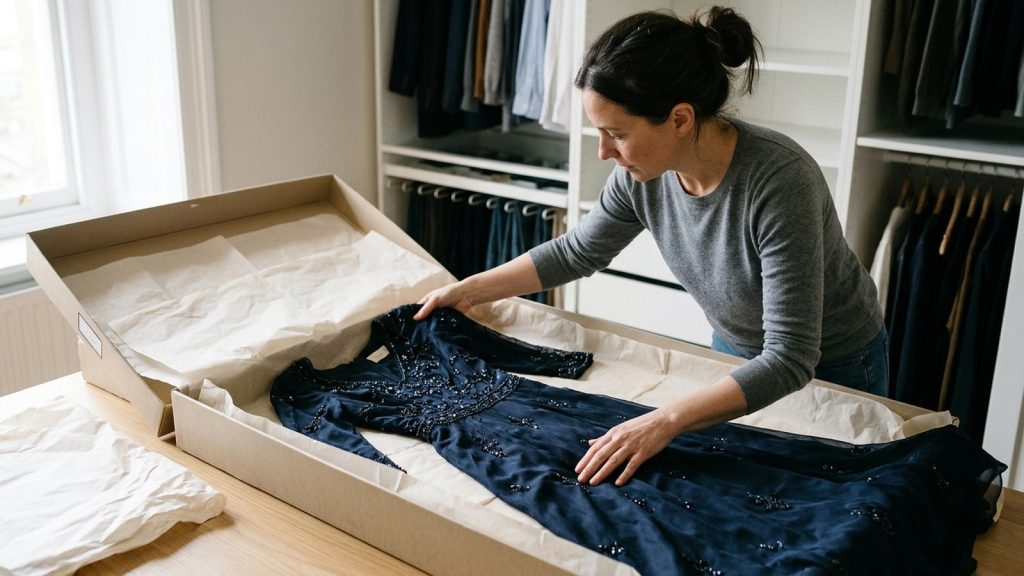
The party is over, and the easiest place for the outfit is back on the hanger it arrived with. That may be fine for a sturdy jacket, but a heavily beaded dress or a bias-cut gown can need a different kind of support. Start by looking at what carries the garment’s weight.
Storage should preserve the piece without making the next wear a repair project. You do not need to turn every closet into a museum. You do need to distinguish an ordinary garment in good condition from something fragile, unusually heavy, or valuable enough to justify specialist advice.
Inspect the outfit before it disappears into the closet
Look for stains, loose embellishments, strained seams, and damp areas around the lining. Check the hem, underarms, neckline, and any place that touched food, cosmetics, or the floor. A small problem is easier to identify before you forget what happened during the event.
Follow the care label and ask a qualified cleaner about uncertain stains or complex decoration. Do not apply several household remedies in succession. A treatment that suits the main fabric can damage trim, lining, adhesive decoration, or a finish you did not notice.
The FTC’s explanation of care labels emphasizes that care instructions need to account for the garment as a whole. Use the label as a starting point, not the assumption that every item described as satin, velvet, or silk requires the same process.
Choose support before choosing a cover
Ask whether the shoulders and seams can support the entire weight comfortably. A sturdy woven jacket and a lightweight dress with sound construction may suit a well-shaped padded hanger. A fragile shoulder, heavy beadwork, or a knit structure may not.
The Canadian Conservation Institute’s textile-care guidance advises against hanging fragile, knit, bias-cut, or heavily decorated garments and those with weak shoulder seams. Although written for valued textiles and collections, that support principle is useful when deciding how to store delicate occasionwear at home.
Do not rely on a narrow wire hanger because it came from a cleaner. A broad padded shape can distribute pressure more gently when hanging is appropriate. Check that the hanger suits the shoulder width and does not push the sleeve outward into an unnatural shape.
When hanging is the practical option
Give the garment enough vertical space that the hem does not rest in a compressed heap. Leave room on both sides so other clothes do not crush sleeves, pleats, or embellishments. A garment cover cannot compensate for a closet packed tightly around it.
Use any purpose-made hanging supports as intended, checking that they are intact. Do not assume decorative straps or fine shoulder ties can carry the garment’s weight. If a support arrangement is unclear, ask the maker or a textile professional before improvising a tight knot or clip.
A loose, clean fabric cover can protect from dust without pressing against raised decoration. Avoid leaving a special garment indefinitely in the thin plastic bag supplied for transport after cleaning. Make sure the outfit is fully dry before covering it, and keep the storage area ventilated.
When flat storage gives better support
A clean box or drawer large enough to support the garment can be a better choice for a heavy or vulnerable piece. Use appropriate acid-free tissue or clean, prewashed unbleached cotton material between the garment and unsuitable surrounding surfaces. Do not substitute colored decorative tissue that may transfer dye.
The Smithsonian’s home textile-storage advice recommends archival boxes and padding between folds for support. Its guidance concerns family heirlooms, so especially old or deteriorating pieces should be assessed individually rather than treated as ordinary washable clothing.
Arrange folds gently along suitable seams or natural garment lines when possible. Pad a fold rather than pressing it sharply. Support sleeves and shaped areas lightly; the aim is to prevent collapse, not to stuff the garment until the fabric is stretched.
Keep heavy objects off the top. If you must share a box, prevent hard trims and embellishments from pressing into neighboring fabric. Avoid frequent stacking and unstacking that requires dragging a delicate piece out from under everything else.
Pay attention to the place, not only the packaging
A dry, dark, reasonably stable indoor location is more useful than an elaborate cover kept in a damp basement or hot attic. Keep garments away from direct sun, heaters, and areas where condensation or leaks are likely. Light can affect colors and fibers even when an outfit is rarely worn.
Clean the storage area and inspect periodically for pests or moisture. Do not assume a pleasant scent proves that clothing is protected. Strongly scented products can leave residues or odors, and pest-control products need to be used only according to their instructions and suitability.
If you find mold, active insects, or widespread damage, separate the affected item from other garments where practical and seek qualified advice. Do not brush contamination through the rest of the closet or try aggressive treatments on a valuable piece without understanding the risks.
Check the shape before the next invitation
Open storage occasionally and examine the shoulders, folds, and decorated areas. If a garment has been folded for a long time, consider carefully changing the fold position where appropriate. Support the whole item when lifting it rather than pulling on a sleeve or a thin strap.
Before an event, take it out early enough to assess its condition. Let it rest in a safe, supported position and decide whether professional pressing or another treatment is needed. Steam is not a universal answer: some fabrics, finishes, and embellishments can be harmed by heat or moisture.
Keep a discreet note with the storage arrangement, recording cleaning and any repair advice, without attaching adhesive labels to the fabric. When you need the outfit again, you will know why it was boxed or hung that way. The right storage method is the one that supports this garment’s construction, not simply the one that fits the most clothing into the smallest space.

 SHEIN Products in 2026: Everyday Finds Worth Exploring Beyond Fashion
 SHEIN Free Trial Program: Apply and Create Reviews That Stand Out